


Darpan Munjal is the builder behind the Squadhelp to Atom evolution, a founder who treats naming as a product, not a slogan. He's spent years turning a scrappy idea into a scaled marketplace by obsessing over how real buyers behave: testing copy and calls-to-action, tightening negotiation flows, and shipping features sellers actually use. Talk to people who've worked with him and a theme pops up fast, calm, methodical execution. Less noise, more shipped code.
Atom reflects that mindset. It's a marketplace engineered around trust and throughput—clean landers, sane payment options, registrar-level control for smoother transfers, and the kind of behind-the-scenes safeguards that keep deals on the rails. The platform serves both brandables and premium one-word names without pretending those behave the same, and it keeps iterating on the plumbing most folks never see- fraud checks, ownership verification, payouts, and post-sale handoffs. It's not flashy, it's useful and that's why it works.
Mike: Talk about the path from Squadhelp to Atom—and what problem are you most focused on solving right now?
Darpan: Squadhelp started as a naming platform, but over time it became obvious that the real pain point wasn't creativity - it was discovery. Buyers weren't struggling to come up with names. They were struggling to find the right name efficiently.
And I think that's why our industry still sees a low 1–2% sell-through rate. Yes, a lot of inventory isn't great. But even strong names are hard to discover. They get buried under pages of text-matched results. If someone searches "finance", anything containing the word "finance" jumps to the top - even when a name like BrightLedger or ClearPeak might be a far better brand for what they're actually building.
The shift from Squadhelp to Atom was about closing that discovery gap. We didn't want buyers scrolling endlessly. We wanted them to feel understood.
Right now our biggest focus is building a true AI-powered discovery engine - one that understands a founder's context, intent, and brand personality, and then surfaces names that genuinely fit. If we can make the right names appear at the right moment, it transforms the entire discovery experience. That's what we're working toward.
Quick note: I am launching my newsletter in January. Sign up now to get access to members-only information, draft copies of every chapter of my updated books, tools, insights and more! Sign up here!
Mike: The rebrand to Atom beyond the new name, what changed in product, process, or positioning that you could actually feel?
Darpan: The rebrand pushed us to get much clearer about who we are and what problem we're solving. And it ended up being one of our best decisions. We saw the impact almost immediately - stronger search rankings, lower CPC, higher CTR, and a noticeable jump in trust. Atom simply felt closer to our mission, and it made it easier to explain why a name is a real business asset.
With that clarity, we rebuilt key parts of the product around a single vision: Atom should be the first stop when someone is launching a business. That meant rethinking discovery so it's driven by AI and context, not just keywords. It meant giving founders better ways to validate names through real audience feedback. It meant integrating trademark risk into the buying flow, improving seller tools so strong inventory is merchandised correctly, and elevating presentation with AI-powered visuals that help founders immediately picture the brand.
Internally, it changed us too. We became more focused and intentional - fewer scattered features, more emphasis on reducing friction and improving outcomes for both buyers and sellers.
Mike: How are .ai, .io, and .co performing against .com in real buyer behavior?
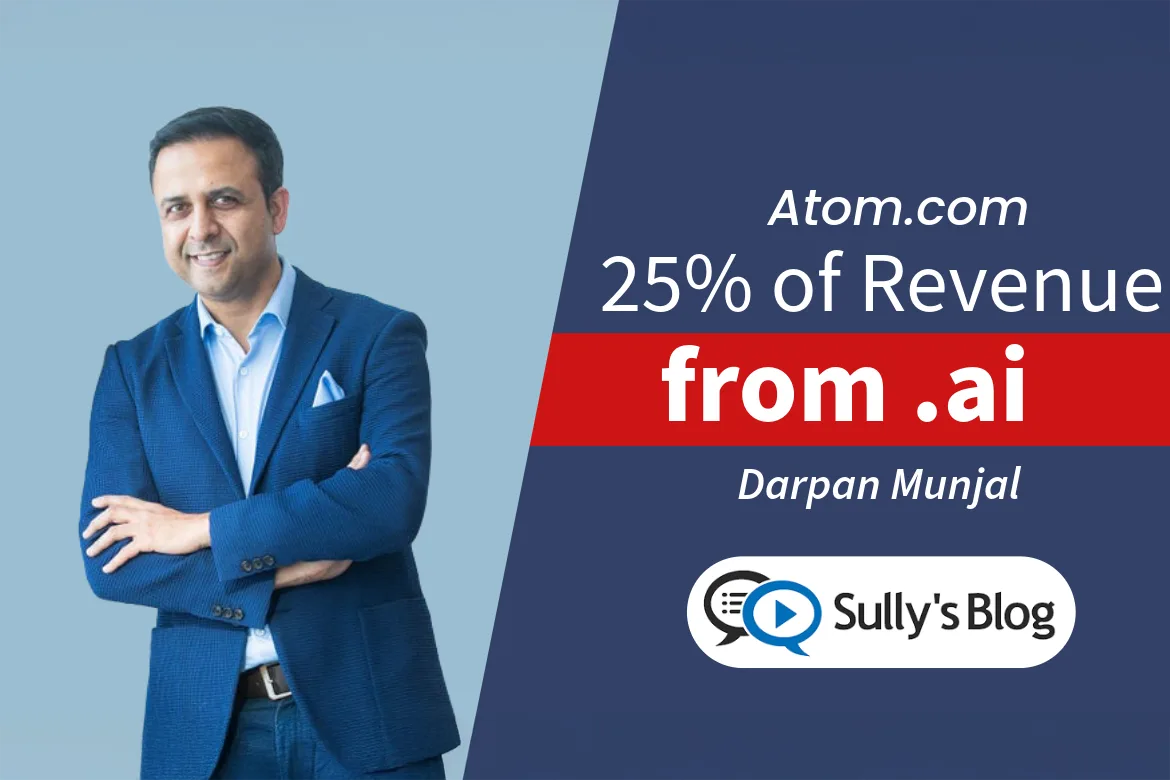
Darpan: .com is still the default for most buyers. It's familiar, trusted, and for many businesses it's still the first choice. But .ai has dramatically changed expectations. On Atom, .ai now accounts for about a quarter of our premium revenue. Many buyers see it as a signal of innovation, not just a fallback when the .com is taken.
.io dipped for a bit, but it has come back strong - especially for developer tools, SaaS, and infrastructure.
.co isn't seeing the same demand right now. It still sells, but not at the pace or price levels we saw a couple of years ago.
We're well past the era where everything has to be a .com. Buyers care about fit - the story the domain tells, the industry norms, and how the name feels. The extension has become part of that story.
Mike: Do payment plans raise close rates, or do they just slow a deal that should have been BIN?
Darpan: Absolutely. Beyond making domains more affordable, payment plans lower the psychological barrier. A founder might hesitate at a $25K BIN, but $625 a month feels doable. And once someone starts building on the name, the likelihood of cancellation drops dramatically.
Do payment plans slow a few deals that might have closed at full BIN? Probably. Some buyers who could pay upfront will still choose the plan. But the upside is much bigger. You get higher overall sell-through, steady monthly revenue, and if a cancellation does happen, you still own the asset and can resell it.
At the end of the day, this business comes down to increasing ASP × STR - how much revenue each domain generates per year on average. Payment plans help both sides of that equation. They widen the funnel, and they also change buyer behavior. When the monthly payment feels reasonable, buyers are less motivated to negotiate heavily, which means more domains end up selling closer to their BIN price.
Mike: How do you decide which names to feature or promote so it's fair and effective?
Darpan: We try to keep the philosophy simple. First, we focus on what's actually relevant to the buyer at that moment. And second, we think about how to scale that judgment without losing the human sense of "fit".
We've trained multiple AI agents to think like end users. Their job is to constantly evaluate search results and adjust placements based on what would genuinely resonate with buyers. Each agent is trained on different branding principles, so there's a healthy tension between them about what deserves to rank at the top. That's intentional- it mimics how different types of founders think.
That's why if someone searches "wellness", they won't just see a list of names containing the word "well". They'll see names like SereneLife.com, LotusBliss.com, or Breath.com - domains that actually feel like wellness brands, even without literal keywords.
We also pay close attention to the metrics that correlate with real purchases: repeat lander visits, price tracking, and performance within high-volume keywords. Raw view counts don't mean much on their own.
And to make this process fully transparent, we now provide a detailed dashboard where sellers can see exactly which buyer search terms their domains are receiving priority placement for. In other words, you can see where our AI agents believe your domain is the strongest fit and are ranking it higher as a result. The goal isn't to create a leaderboard, it's simply to surface the right names for the right buyer at the right time.
Mike: Domain purchase & transfers still feel archaic in places—what should the industry standardize to remove needless friction?
Darpan: Transfers feel archaic because the industry is still running on infrastructure that was never built for instant digital transactions. Everything takes too many steps, involves too many manual checks, and depends on systems that don't talk to each other. That creates friction for buyers and long delays for sellers.
This was one of the main reasons we decided to build our own registrar stack from the ground up. We wanted to automate every part of the domain purchase process so a name can realistically change hands in minutes, not days. Our near-term goal is three hours from purchase to payout. And we're already seeing many .com transfers complete in under an hour on our marketplace because our registrar automation handles most of the workflow behind the scenes.
If you think about how quickly money moves today - instant payments, same-day settlement etc, there's no reason domain transfers should feel like a slow, manual, multi-day process. The industry needs to move toward real-time ownership updates, automated approvals, and predictable transfer flows. That's the direction we're pushing in with Atom.
Mike: Before setting a BIN, what data should a seller actually look at (and what should they ignore)?
Darpan: Before you look at any data, the first step is simple: put yourself in the buyer's shoes. If you were building a serious business in that space, would you actually pick this name? If the honest answer is no, no amount of data will fix that.
From there, a few things really matter:
- Industry fit: Names that align with high-value categories like AI, health, finance, SaaS, or other B2B/tech verticals can typically command higher prices than names that only make sense for a small lifestyle brand or local business.
- Market signals: Look at what's happening around that name:
- How many other extensions are taken, and ideally registered by different buyers?
- Are there live websites on other extensions?
- Are there trademarks filed that include the term? Not because you want to target those companies, but because it's a signal of real commercial interest.
- Real buyer behavior: On a marketplace like Atom, I'd look at repeat lander visits, how frequently buyers track the price, and whether the name is generating real inquiries or negotiations. These signals correlate far more with actual sales than raw view counts.
And there are a few things I wouldn't overweight:
- Raw traffic or view numbers by themselves.
- Automated appraisals taken literally.
- Opinions from other investors that aren't backed by data.
- The emotional "I'd never sell this for less than X" anchor.
None of these signals are perfect on their own. Some of the best brandable names are so distinctive that you won't find obvious comps or much development in other extensions. That's why pricing is part science and part intuition.
We've built, and continue to refine, our appraisal tool (and Chrome extension) at Atom to bring all these signals together at scale. But at the end of the day, you still need that honest founder test: Would I build on this name at this price?
Mike: What is your take on AI? Not as a TLD, but as a technological reality that we are either ignoring or embracing?
Darpan: AI isn't another trend. It's a fundamental shift in how humans will work, build, and make decisions. We're moving into a world where intelligence becomes a utility: accessible on demand, able to reason, create, and collaborate. That will reshape every industry. Barriers to starting a company will fall dramatically. Millions more people will be able to turn ideas into reality because the cost of creation keeps dropping.
It also raises the bar. When everyone has access to powerful tools, the advantage goes to the people and companies that embrace them early.
At Atom, we're leaning into this fully. AI is already central to how we understand buyer intent, rank domains, create brand presentations, and help founders make confident decisions. The next wave of company creation will be AI-first, and we want naming and brand identity to feel just as fast and intuitive as the rest of that process. Our job is to build tools that match the speed at which founders will build.
Mike: Close us out with one habit sellers can adopt this quarter that will actually move their revenue.
Darpan: Spend most of your time buying better names. The majority of your effort should go into choosing quality inventory, because everything else gets easier when the names themselves are strong.
A lot of investors get caught up in dashboards - traffic spikes, view counts, metrics that look interesting but don't actually drive sales. None of that matters if the core assets aren't solid.
Instead, focus on what's truly actionable. Ask yourself whether a real founder would build on this name, whether it fits a meaningful industry, whether it has the longevity to hold value, and whether you're giving it enough exposure for buyers to actually find it.
If you get the buying right, everything downstream - pricing, inquiries, STR, naturally improves. If you don't, no amount of analytics will save the portfolio.
So my advice is simple: put your energy into the front of the funnel. Buy with conviction, tune out the noise, and make sure your best names are visible in as many places as possible. Everything after that is just fine-tuning.