




I still remember reading in the newspaper back in 1999 that Marc Ostrofsky sold Business.com for $7.5 million and thinking "holy shit, domains are actually worth something." But that sale, as crazy as it seemed at the time, was clean. Legal. Both parties walked away happy.
The story of Sex.com? Completely different animal.
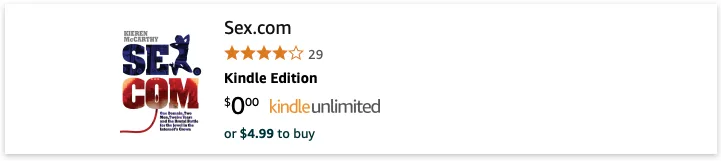
Kieren McCarthy's book about this domain reads less like a business case study and more like a crime thriller where everyone involved is either brilliant, insane, or some combination of both. If you're even remotely interested in domains, you need to read this. Not because it's some masterclass in investing strategy, but because it's the most batshit crazy story in domain history and it actually happened.
How to steal millions with a fax machine
The early internet was absolute chaos. No rules, no security, no real understanding that these digital addresses could be worth anything. Gary Kremen registered Sex.com in 1994 because he understood—earlier than most—that online real estate was going to matter.
Then Stephen Cohen comes along.
Cohen didn't buy the domain. Didn't negotiate. Didn't make an offer. He just... took it. With a forged fax. That's it. A piece of paper with a fake signature, sent to Network Solutions, and suddenly one of the most valuable domains on the internet belonged to a conman.
No registrar locks back then. No two-factor authentication. No ICEP or ICANN procedures to protect you. Just "hey, this fax says transfer the domain" and it was done. The Wild West doesn't even begin to describe how vulnerable everything was.
The people in this are unbelievable
Gary Kremen is the kind of person who will fight you forever if he thinks he's right. Brilliant, stubborn as hell, and apparently willing to burn through his entire life savings to win a point. Some people would call that admirable. Others would call it obsessive. Probably both are true.
He could've walked away so many times. People kept telling him to. "It's just a domain, move on with your life." But he couldn't let it go. Whether that's principle or stubbornness or just raw spite, I don't know. Maybe all three.
And Stephen Cohen? This guy is something else. A career fraudster who saw the Sex.com opportunity and just went for it with zero hesitation. After stealing the domain, he didn't even try to lay low. He flaunted it. Made millions off the traffic. Lived large while Kremen was in court bleeding money trying to get his property back.
The balls on this guy. At one point during the legal proceedings, Cohen literally fled the country. Just disappeared to Mexico with whatever assets he could move, leaving Kremen with a court victory but no way to collect. You can't make this stuff up.
Years in court fighting over something that "didn't exist"
The legal battle went on forever. Years of Kremen's life, mountains of legal bills, and judge after judge struggling to understand what the hell a domain name even was. Is it property? Is it a contract? Does regular theft law even apply to something digital?
The courts weren't ready for this. The legal system was designed for physical assets—land, cars, jewelry. Now suddenly they're being asked to rule on whether someone can "steal" a string of characters that exists nowhere and everywhere at once.
Kremen had to spend years explaining basic internet concepts to judges who could barely check their email. And the whole time, Cohen's making money hand over fist from the stolen asset while hiding behind legal delays and jurisdictional nonsense.
Eventually Kremen won. Got a judgment for $65 million. But collecting it? That's where things get even messier. Cohen had already moved assets around, fled to Mexico, and made himself essentially judgment-proof. Winning in court and actually getting justice turned out to be two very different things.
What this means if you actually own domains
The story is entertaining as hell, but it's also a warning. A few things stood out to me:
Lock everything down. We have security tools now that didn't exist in the '90s. Two-factor auth, registrar locks, all of it. Use them. Don't assume your registrar will protect you if you get lazy about security.
Be ready to fight if something matters. Kremen spent years and a fortune on this case. Most people wouldn't have had the resources or the stubbornness to see it through. If you own something valuable, you better be prepared to defend it, because someone will eventually try something.
The system still doesn't fully get domains. It's better than it was, but we're still explaining to courts why virtual property has real value. That creates risk you need to be aware of.
Early movers see value others miss. People laughed at domain investing in the '90s. Thought it was ridiculous. Some people are still laughing at certain extensions or categories today. Being early to real value means dealing with skeptics until you're proven right.
The cost nobody talks about
McCarthy doesn't shy away from showing what this fight did to the people involved. Kremen's finances got destroyed. His personal relationships suffered. Years of his life consumed by this single obsession to get back what was stolen.
Cohen ended up living like a fugitive, always looking over his shoulder, burning bridges everywhere he went.
When you see headlines about big domain sales, it's easy to think it's all just easy money and smart investments. This book reminds you there's often a human cost behind those numbers. People's lives get tangled up in these fights in ways that go way beyond dollars and cents.
Relevant?
The Sex.com case happened over twenty years ago, but it's still relevant because it forced the legal system to recognize domains as legitimate property. Before this case, the law was ambiguous. After it, there was precedent. Domains weren't just technical addresses anymore—they were assets you could own, steal, and fight over in court.
It also established something darker: wherever there's money in domains, there are people looking for shortcuts. Theft, fraud, hijacking—all of it is still happening today, just with more sophisticated methods than a faxed forgery.
Understanding this history helps you see the current market more clearly. The tools are better now, the legal framework is stronger, but the fundamental dynamic hasn't changed. Valuable domains attract both legitimate buyers and people looking to take them by force.
Just read it
Sex.com isn't just about a domain. It's about the internet growing up in real-time, a legal system scrambling to catch up with technology, and one stubborn bastard who refused to let a thief win even when everyone told him to quit.
For domain investors, it's basically required reading. If you're new to this space, it'll show you what the stakes can actually be. If you've been around for a while, it's a reminder of how far we've come—and how much of the old chaos is still lurking under the surface.
Kremen eventually won his case. Got his domain back. But it took years and cost him more than money. The domain itself remains legendary not just for its obvious commercial value, but for what it represents: the first major fight over digital property in a world that didn't yet understand what that meant.
I finished the book entertained, angry on Kremen's behalf, and way more paranoid about domain security than I was before. These assets might be virtual, but the fights over them? Those are as real as it gets.