


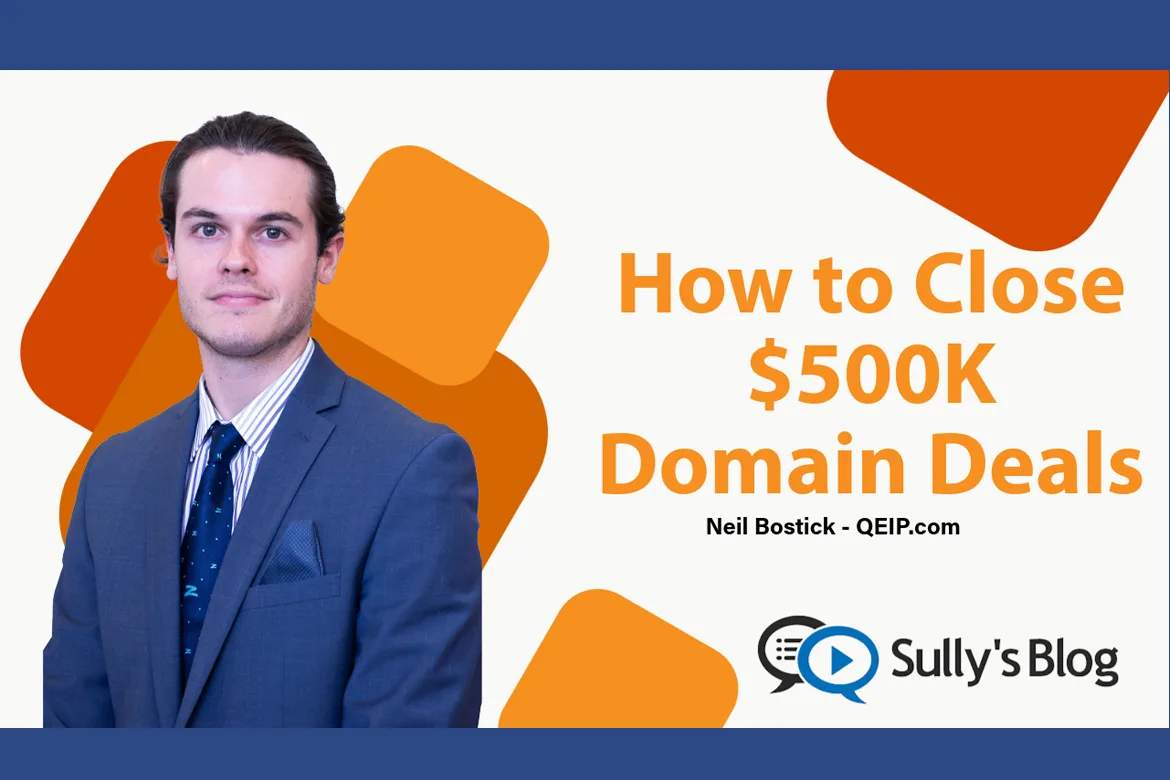
Back in September 2020 on SullysBlog, we talked with Neil Bostick about practical ways to pick winning names and the operator mindset behind them. Since then, he’s stayed busy at the top end of the market—continuing his brokerage work at QEIP, expanding his practice at FIH.com, and launching Graen.com, a private marketplace built to match premium domains with accredited buyers under confidentiality.
He’s also taken on high-visibility buyer representation, including the Fuse.com acquisition reported at $2,129,509, and he’s been vocal about why some seven-figure deals need to stay quiet until the ink is dry. The through-line is the same as last time: disciplined process, clean negotiation, and a preference for outcomes over noise. Let’s pick up where we left off and get into what’s changed—and what hasn’t—since that first interview.
Mike: What’s changed most in your process since our 2020 chat, where did you tighten the screws or Simplify?
Neil: Thanks for having me again! Hard to believe it’s been five years. A lot has evolved, though the fundamentals - discipline, relationships, and outcomes - remain constant. For this conversation, I’ll focus on QEIP, even though FIH.com now consumes most of my time. Domain brokerage and M&A; have always been relationship-driven industries. When I started, I wanted to make them more data-driven. Deals in this space often hinge on trust, which is critical, but I believed we could amplify that trust with data: not just valuation data, but ownership, buyer sourcing, and behavioral data.
We treat connecting owners and acquirers like a matching algorithm problem: how do you map the right buyer to the right domain faster than anyone else? That mindset built both QEIP.com and FIH.com. Over time, we’ve refined our proprietary data pipelines and automated outreach systems to identify ideal end-user buyers and direct decision-makers with precision.
In 2020, I handled most deals over email. In 2025, my calendar’s full of video calls because high-value transactions aren’t just about data, they’re about trust and education. Our edge now lies in pairing data-backed outbound processes with authentic human relationships.
Mike: You launched Graen.com as a private, accredited marketplace, what problem were you solving that public venues couldn’t?
Neil: Graen was built as the platform I wished existed. I wanted a place where serious buyers could transact confidentially, without the noise of public listings, and where sellers could list high-value assets with real protection and price integrity.
In truth, Graen’s been in a bit of limbo. It’s a competitive space and any B2C marketplace needs serious marketing investment and education. We’re now re-focusing on a tighter niche: a private exchange for three-letter .COMs, which will likely replace or reformat the current Graen.com. The goal is price efficiency, asset protection, while not restricting a given seller.
Mike: On the sell side, what setup details reliably raise close rates beyond BIN vs make-offer?
Neil: I’ve become a fan of the private bidding process. Instead of listing at a fixed BIN or vague make-offer, we establish a bidding window with a clear minimum or suggested bid. This structure drives competition, creates urgency, and keeps perceived value high.A good landing page explaining the process, paired with targeted outbound outreach, can turn a five-year waiting game into a two-month closing cycle. It’s about engineering momentum.
Mike: When a negotiation stalls, how do you create movement without cutting price?
Neil: Payment-term flexibility is my favorite lever. For instance, if a buyer offers $120K and the seller declines, then comes back later wanting to accept, only to realize that the buyer withdrew their offer, rather than dropping the price, I might propose $20K per month over six months or some other payment plan style offer at a similar price. That often bridges psychological gaps while maintaining the headline value.
For many buyers, especially those with assets tied up in crypto or venture liquidity cycles, a structured plan makes the deal feasible. You’re solving for cash flow, not valuation.
Mike: What objections do you hear most from buyers now, and how do you address them?
Neil: Education is still the biggest hurdle. Many buyers simply don’t understand how a premium domain directly impacts conversion rates, trust, and customer acquisition cost. I use what I call the added revenue framing. Let’s say I’m selling SMBs.com for $500K to a SaaS company currently on WeAreSMBs.ai. If that company spends $750K a year in marketing and generates $1.5M in sales, I’ll walk them through how a stronger domain can lift conversion efficiency.
Even a modest increase, say from $1.5M to $2.5M annually, creates $3M in incremental revenue over three years. That reframes a $500K domain as a high-ROI acquisition. This data-driven, narrative-backed approach closes deals because it anchors domains as business assets, not vanity purchases.
Mike: How’s demand for non-.COM TLDs actually playing out in transactions?
Neil: I’ve always kept an open mind, but the data doesn’t lie. COM remains king. We’ve seen spikes in .AI and .IO, similar to .CO a decade ago, but they follow hype cycles. When markets cool, these alternatives drop sharply while .COMs hold value.
Think of .AI domains as alt-coins in crypto, tied to broader enthusiasm rather than fundamentals. Once AI becomes embedded in every company, having “AI” in your domain will feel redundant. I’ve yet to see a non-.COM outperform a strong .COM asset in long-term ROI.
Mike: How do you approach anchor pricing in buyer representation?
Neil: Anchoring is powerful psychology. When you say the price is $50K, you set a ceiling. When you say minimum offer $50K, you set a floor, and both feel the same to a buyer. That subtle difference shifts the negotiation dynamic. Of course, you need data to justify either anchor, like previous offers, sales comps, or quantified brand value. It’s art supported by analytics.
Mike: Any data habits that improved measurable outcomes?
Neil: Absolutely. We built a custom CRM that tracks every lead, contact, and engagement for each outbound campaign. It’s one thing to send outreach; it’s another to know who opened, who replied, and when to re-engage.
A surprising number of deals come from rekindling old conversations. Many buyers circle back months or even years later once timing aligns. Having structured data makes those follow-ups both natural and scalable.
Mike: For investors holding a few elite names, what outreach cadence works in 2025?
Neil: I’d structure it like a mini-auction cycle. Choose a selling horizon, whether two months or two years, and plan a three-touch sequence: kickoff announcement, mid-campaign reminder, and final bids due notice.
This method creates momentum and urgency without burning relationships. Some of the world’s largest companies use this same model when divesting high-value assets. It works just as well for premium domains.
Mike: What one habit should sellers build this quarter to win their next negotiation?
Neil: Learn to say no strategically… but also don’t be afraid to accept the first offer if it’s the right offer. Everyone dreams of the $1M payday, but few have the conviction to turn down $100K, $500k, $900k offers to reach it. The irony is that when you decline poorly, or let ego drive the moment, you can lose both the deal and the buyer’s respect. On the other side, being too greedy about a good up-front offer can also kill a deal and have a buyer walk away permanently.
Know your walk-away logic in advance. Decline offers decisively but professionally, and have a data-backed reason. That balance of confidence and evidence is what turns a good broker into a great one.