


The Domain Name System (DNS) is the invisible backbone of the internet, quietly translating human-readable domain names into IP addresses that computers understand. For domain investors, understanding DNS isn't just technical knowledge—it's a strategic advantage that can significantly impact the value, functionality, and monetization potential of your domain portfolio.
Whether you're parking domains, developing them into revenue-generating websites, or preparing them for sale, DNS configuration plays a crucial role in maximizing your investment returns.
What is DNS and Why Should Domain Investors Care?
DNS functions is commonly referred to as the internet's phone book (an odd reference since no one uses phone books anymore), maintaining a distributed database that maps domain names to their corresponding IP addresses. When someone types "example.com" into their browser, DNS servers work behind the scenes to resolve that domain name to the appropriate server's IP address, enabling the connection to occur.
For domain investors, DNS represents far more than just technical infrastructure. It's the bridge between your domain assets and their potential value realization. Proper DNS configuration can mean the difference between a domain that generates passive income through parking and one that sits idle, between a domain that ranks well in search engines and one that remains invisible, and between a smooth sale process and technical complications that could derail a deal.
Understanding DNS empowers you to make informed decisions about domain development, parking strategies, and portfolio management. It also helps you communicate more effectively with buyers, developers, and hosting providers, positioning you as a knowledgeable professional in the domain industry.
The Architecture of DNS: How It All Works Together
DNS operates on a hierarchical structure that begins with root servers and cascades down through Top-Level Domain (TLD) servers to authoritative name servers. This distributed system ensures redundancy, speed, and reliability across the global internet infrastructure.
When you register a domain, you're essentially claiming a spot in this hierarchy. Your domain registrar provides you with the ability to set name servers, which are the authoritative sources for your domain's DNS records. These name servers can be managed by your registrar, a separate DNS hosting service, or even your own infrastructure if you have the technical expertise.
The beauty of this system lies in its flexibility. You can change your DNS configuration at any time, redirecting traffic, adding new services, or modifying how your domain behaves without needing to update the domain registration itself. This flexibility is particularly valuable for domain investors who need to adapt their domains for different purposes throughout their investment lifecycle.
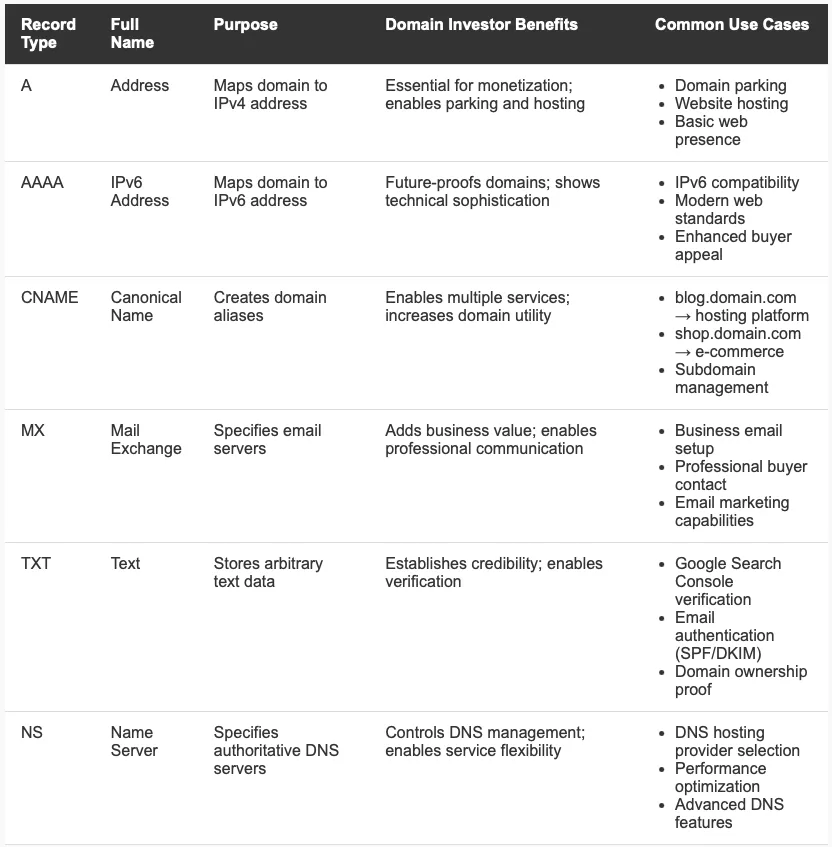
DNS Record Types Reference Table
A Records: The Foundation of Web Presence
A records are the most fundamental DNS record type, directly mapping your domain name to an IPv4 address. When someone visits your domain, the A record tells their browser exactly which server to contact. For domain investors, A records are crucial for domain parking, basic website hosting, and creating a functional web presence.
Setting up A records is typically your first step in monetizing a domain. Whether you're pointing to a parking service, a simple landing page, or a fully developed website, the A record makes your domain accessible to visitors. Many domain parking services provide specific IP addresses for you to use in your A records, enabling them to serve targeted advertisements and generate revenue from your domain traffic.
AAAA Records: Future-Proofing Your Domains
AAAA records serve the same function as A records but for IPv6 addresses. As the internet continues its transition to IPv6, having AAAA records becomes increasingly important for ensuring your domains remain accessible to all users. Forward-thinking domain investors include AAAA records in their DNS configuration to future-proof their assets and demonstrate technical sophistication to potential buyers.
CNAME Records: Flexibility and Efficiency
CNAME (Canonical Name) records create aliases for your domain, allowing you to point subdomains to other domains or services. This is particularly useful for domain investors who want to create multiple branded experiences from a single domain or who need to integrate various third-party services.
For example, you might use a CNAME record to point "blog.yourdomain.com" to a hosted blogging platform, or "shop.yourdomain.com" to an e-commerce service. This flexibility allows you to quickly deploy different services without managing multiple separate domains, potentially increasing the overall value of your domain investment.
MX Records: Email Capabilities Add Value
MX (Mail Exchange) records specify which mail servers handle email for your domain. Having proper MX records configured demonstrates that your domain is capable of handling email communication, which can be a significant value-add for potential buyers, especially those looking to use the domain for business purposes.
Many domain investors overlook email configuration, but having functional email capabilities can differentiate your domain from competitors and justify higher asking prices. Even if you're not actively using email for the domain, having the infrastructure in place shows buyers that the domain is ready for immediate business use.
TXT Records: Verification and Trust Signals
TXT records store arbitrary text data and serve various purposes, from domain verification to email authentication. For domain investors, TXT records can be crucial for establishing trust and credibility. They're used for Google Search Console verification, email authentication protocols like SPF and DKIM, and various other verification processes.
Having proper TXT records demonstrates that your domain has been professionally managed and can help establish legitimacy with both search engines and potential buyers. This is particularly important for domains in competitive niches where trust and authority are paramount.
NS Records: The Control Center
NS (Name Server) records specify which servers are authoritative for your domain's DNS information. While you might not change these frequently, understanding NS records is crucial for domain investors who want to maintain control over their DNS configuration or who need to transfer domains between different hosting providers.
Some domain investors prefer to use specialized DNS hosting services that offer better performance, more features, or superior reliability compared to their registrar's default name servers. Understanding NS records allows you to make these strategic decisions about your domain infrastructure.
DNS Configuration Strategies for Domain Investors
Parking Optimization Through DNS
Domain parking remains one of the most popular monetization strategies for domain investors, and DNS configuration plays a critical role in parking success. Most parking services provide specific A records or name servers that you need to configure for your domains. However, the way you implement these settings can impact your parking revenue.
Some parking services offer geographic targeting, allowing you to serve different content to users from different locations. This requires sophisticated DNS configuration using services that support geographic DNS routing. By directing European visitors to European parking pages and American visitors to American parking pages, you can potentially increase click-through rates and revenue.
Additionally, consider using DNS services that offer traffic analytics. Understanding where your domain traffic comes from, what devices visitors use, and how they find your domains can help you optimize your parking strategy and make informed decisions about which domains to develop further.
Development and Staging Environments
For domain investors who develop their domains, DNS configuration becomes even more complex but also more powerful. Setting up staging environments using subdomains allows you to test new features, designs, or content without affecting your live domain. This is particularly important for high-value domains where any downtime or issues could result in lost revenue or damaged reputation.
Using DNS, you can create sophisticated development workflows that include staging servers, content delivery networks, and backup systems. This professional approach to domain development not only protects your investment but also demonstrates to potential buyers that the domain has been managed with care and expertise.
Email Marketing and Communication
Many domain investors underestimate the power of email marketing for their domains. By properly configuring MX records and setting up email systems, you can build mailing lists, communicate with visitors, and create ongoing relationships that extend beyond single visits to your domains.
Email capabilities also enable you to create professional communication channels for domain sales inquiries. Having a proper email address that matches your domain (like inquiry@yourdomain.com) appears more professional than using generic email services and can help establish credibility with serious buyers.
The Impact of DNS on Domain Valuation
DNS configuration directly impacts how search engines crawl and index your domains, which in turn affects their search engine optimization (SEO) value. Properly configured DNS with fast resolution times, minimal downtime, and appropriate record types can improve your domain's search engine rankings, making it more valuable to potential buyers.
Page load speed is a crucial SEO factor, and DNS resolution time is a component of overall page load speed. Using high-performance DNS services can improve your domain's technical SEO metrics, potentially increasing its value. Many domain appraisers and buyers now consider technical factors like DNS performance when evaluating domains.
Furthermore, having a complete and professional DNS setup demonstrates to buyers that you've invested time and resources in maintaining the domain properly. This attention to detail can justify higher asking prices and reduce the likelihood of technical issues during the sale process.
Advanced DNS Techniques for Serious Domain Investors
Geographic DNS Routing
Geographic DNS routing allows you to serve different content to users based on their location. This can be particularly valuable for domain investors with generic or geographic domains. For example, if you own a domain related to "pizza delivery," you could use geographic DNS to redirect visitors to different local pizza delivery services based on their location, potentially increasing affiliate commissions or advertising revenue.
Load Balancing and Redundancy
For high-traffic domains, implementing DNS-based load balancing can improve performance and reliability. This involves configuring multiple A records with different IP addresses, allowing traffic to be distributed across multiple servers. While this level of sophistication isn't necessary for most domain investors, it can be valuable for premium domains that generate significant traffic.
Dynamic DNS and Real-Time Updates
Some domain investors use dynamic DNS services that allow real-time updates to DNS records. This can be useful for domains that need to respond quickly to changing conditions, such as domains used for limited-time promotions or events. While not common in traditional domain investing, this technique can be valuable for investors who actively manage and optimize their domains.
Common DNS Mistakes That Hurt Domain Value
Many domain investors make DNS configuration mistakes that can significantly impact their domain's value and functionality. One of the most common errors is using slow or unreliable DNS services, which can result in poor user experiences and lower search engine rankings.
Another frequent mistake is neglecting to configure proper email settings, missing opportunities to build relationships with domain visitors or appear professional to potential buyers. Similarly, failing to set up proper redirects for common variations (like www vs non-www) can result in lost traffic and confusion.
Perhaps most critically, many domain investors don't regularly monitor their DNS configuration, leading to situations where domains become inaccessible due to expired DNS hosting or configuration errors. Regular DNS audits should be part of every domain investor's portfolio management routine.
The Future of DNS and Domain Investing
As the internet continues to evolve, new DNS technologies and standards are emerging that could impact domain investing. IPv6 adoption is accelerating, making AAAA records increasingly important. New DNS security features like DNS over HTTPS (DoH) and DNS over TLS (DoT) are becoming standard, potentially affecting how domains are accessed and valued.
Additionally, the rise of decentralized DNS systems and blockchain-based domain alternatives represents a potential disruption to traditional domain investing. While these technologies are still emerging, savvy domain investors should stay informed about these developments and consider how they might impact their investment strategies.
DNS as a Strategic Asset
Understanding DNS is no longer optional for serious domain investors—it's a strategic necessity. Proper DNS configuration can increase your domain's value, improve its functionality, and create new monetization opportunities. More importantly, DNS knowledge empowers you to make informed decisions about your domain portfolio and communicate effectively with buyers, developers, and service providers.
Whether you're just starting in domain investing or managing a portfolio of thousands of domains, investing time in understanding DNS will pay dividends. The technical knowledge you gain will help you identify opportunities that other investors miss, avoid costly mistakes, and position yourself as a professional in the domain industry.
As the internet becomes increasingly complex and competitive, domain investors who understand the technical foundations of their assets will have a significant advantage. DNS is one of those foundations, and mastering it will serve you well throughout your domain investing career.
Learn even more about DNS and Domaining here.