


I got an email from a friend last week showing me his negotiation thread for a domain he just bought. He's launching a new venture and needed the right name. The whole exchange is sitting in my inbox, and reading through it reminded me how much distance there is between what domain investors think founders care about and what founders actually care about.
We keep talking to ourselves about keyword strength and comparable sales and market positioning. Meanwhile, the people actually buying domains are thinking about completely different things.
The retirement hobby that wasn't
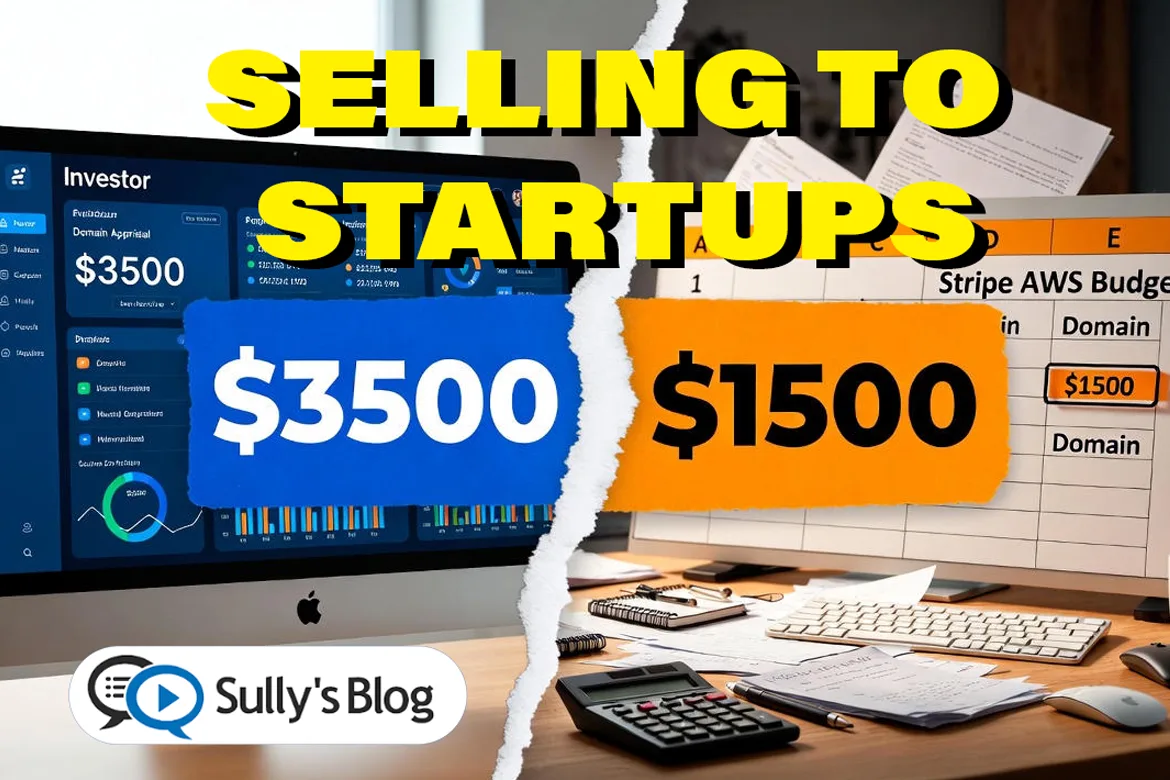
My friend Don positioned himself as someone starting a "retirement hobby" when he reached out about a domain listed at $3,500. The broker came back at $2,888. Don held firm at $1,500, saying it was already more than he wanted to spend. Eventually got it for exactly $1,500.
Now here's the thing—Don isn't some retiree tinkering in his garage. He's a sharp operator launching what could be a real business. But he knew exactly what card to play. "Retirement hobby" signals low budget, low urgency, take it or leave it. It worked.
The broker tried the standard moves. Domains are valued based on many factors such as marketability and brand-ability, the industry it is related to, similar domain sales..." All true. All irrelevant to the buyer.
Don didn't care about comparable sales or domain appraisals or any of the stuff we think justifies pricing. He cared about one thing: does this domain work for what I'm building, and can I afford it without feeling stupid?
That's the gap. We're selling assets. They're buying tools.
Do you want more stories like this one? Sign up for my newsletter launching in just a couple of weeks.
What founders actually optimize for
I've sold maybe twenty domains to actual startup founders over the years. Not domain investors, not resellers—people building real businesses who needed a name. And the pattern is consistent enough that I've stopped being surprised by it.
Founders don't optimize for domain quality the way we think about it. They optimize for removing friction from their launch checklist.
They want a name that sounds legitimate enough that customers won't question it. They want something they can explain to their co-founder or their spouse without a long backstory. They want to move on to the next problem, which is usually way more urgent than the domain.
The domain matters to them, but it matters like office furniture matters. It needs to work. It needs to not be embarrassing. Beyond that, they'd rather spend energy on product or hiring or fundraising or any of the hundred other things that feel more directly connected to survival.
When I've closed sales with founders, the conversations are almost never about the domain itself. They're about logistics. How fast can we transfer? What payment methods do you take? Can you send an invoice my accountant will accept? Do I need to do anything technical or can you handle it?
Compare that to selling to another domain investor. Those negotiations are all about the domain. Comps, metrics, traffic, development potential, alternate buyers. When you're selling to a founder, the domain is already pre-sold in their head. They reached out because they've decided they want it. Now they're just trying to figure out if the price makes sense and whether the transaction will be annoying.
The budget reality nobody talks about
Here's what I wish more domain investors understood: most founders can't actually afford what we think domains are worth.
Not because they're broke, but because they're managing a dozen competing budget priorities and the domain is pretty far down the list. If you're a founder with $50,000 in the bank and you're trying to get to product-market fit, spending $5,000 on a domain feels insane. That's a contractor for a month. That's three months of software subscriptions. That's runway.
Don's offer of $1,500 wasn't lowballing. It was probably exactly at the edge of what made sense for his budget and his stage. Could he have afforded $2,888? Maybe. But the mental math changes when you're the one writing the check and you know you've got twenty other expenses coming.
I used to take offense at offers like that. Now I just try to figure out if the founder is real, if the price makes sense for the domain, and if there's a deal to be made. The offers aren't insulting. They're just operating in a different economy than the one domain investors imagine exists.
Most of my startup sales have been in the $1,500 to $4,000 range. I've had a few go higher, but not many. And these weren't trash domains—they were decent two-word .coms, brandable names that worked for real businesses. The founders who bought them didn't think they were getting a steal. They thought they were paying a fair price for something they needed.
Which they were.
The branding conversation is backwards
We love talking about how a premium domain "elevates the brand" and "saves marketing costs" and "establishes credibility instantly." I've said all of those things. I believe some of them.
But founders aren't buying domains for branding leverage. They're buying them to avoid branding friction.
There's a difference. Branding leverage is proactive—it's the idea that a great domain actively helps you compete. Branding friction is defensive—it's the idea that a bad domain creates problems you don't want to deal with.
A founder choosing between GoodDomain.com at $3,000 and OkayDomain.io at $800 isn't thinking "which one will make my brand stronger?" They're thinking "which one won't hurt me, and which one lets me keep more cash for the things I know I need?"
The premium domain might objectively be better. But "better" has to be $2,200 better, and that's a hard case to make when you're pre-revenue and trying to stretch every dollar.
I've learned to sell domains to founders by acknowledging this reality instead of fighting it. I don't pitch credibility and brand equity. I pitch simplicity and legitimacy. "This domain won't raise questions. It'll sound like a real company. You'll never have to explain the spelling or the extension. That's what you're paying for."
That tends to land better than talking about SEO value or comparable sales.
The speed and certainty they actually want
One thing Don's email thread showed clearly: once he decided on his price, he wanted it done immediately. "I am planning on starting my hobby this week, and will be moving to an alternative."
Founders operate on different timelines than domain investors. We'll hold a domain for five years waiting for the right offer. They need to make a decision this week because their developer is asking what URL to use for staging.
When I'm negotiating with a founder now, I optimize for speed and certainty over price. If someone makes a reasonable offer and seems real, I'd rather close at 80% of my target price today than hold out for 100% over the next six months. Because that founder is going to move forward with something. If it's not my domain, they'll pick an alternative and I've lost the sale entirely.
The broker in Don's thread took four days to go from $3,500 to $1,500. That's actually pretty fast by domain standards, but I wonder if moving faster would've gotten them to $1,800 or $2,000. Once a founder starts thinking about alternatives, you're competing against "let's just move on."
I've started including language in my responses to founder inquiries that emphasizes how quickly we can close. "I can send you a payment link today and transfer the domain within 24 hours." That's not a throwaway line. For founders, speed is part of the value proposition. They're not collectors evaluating purchases. They're operators trying to check boxes.
What this means for how we sell
If you're selling primarily to other domain investors, ignore everything I just said. That's a different game with different rules.
But if you're trying to sell to actual end users—founders starting businesses—you probably need to rethink your approach.
Price domains based on what founders can actually afford at different stages, not what you think the domain is theoretically worth. A pre-revenue startup has a different budget than a Series A company. Adjust accordingly.
Make the transaction as easy as possible. Accept multiple payment methods. Provide clear instructions. Don't make them work to give you money.
Optimize for speed. Founders want to make a decision and move on. Long negotiations kill deals.
Stop selling domain features and start selling certainty. They don't want the best domain. They want a domain that definitely won't be a problem.
And maybe most importantly: recognize that founders aren't trying to lowball you when they offer less than your asking price. They're offering what makes sense in their world, which operates on different math than ours.
Don got his domain for $1,500. The seller probably wanted more but took the deal. Both sides are fine with the outcome. That's what a working market looks like, even if it doesn't match what domain investors wish the market was.
I'm still figuring this out. But the more I sell to actual founders, the more I realize the gap isn't in their understanding of domain value. It's in our understanding of founder priorities.